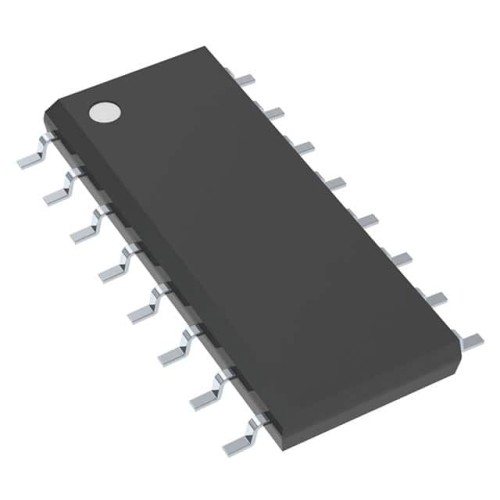
The unassuming IC inverter, specifically the 6-channel, single-input 16SOIC device like Texas Instruments' CD4049UBDRE4, represents a foundational building block in countless electronic systems. While not a headline-grabbing processor or sensor, this component's enduring relevance offers a fascinating lens through which to view the current state of the electronics industry. For procurement teams, understanding the dynamics surrounding this seemingly simple part is critical for strategic sourcing and risk mitigation.
The Technology and Its Evolution
The CD4049UBDRE4 is a classic CMOS hex inverter, part of the 4000-series logic family. Its technology is inherently robust: it offers a wide operating voltage range (3V to 18V), high noise immunity, and very low static power consumption. The "UB" designation indicates an unbuffered output, which provides a more linear transfer characteristic, making it useful in linear applications like crystal oscillators and pulse shapers. Recent innovations in this segment are not about radical architectural changes but about incremental improvements in process technology. Texas Instruments and other major players have refined their manufacturing nodes to reduce dynamic power consumption and improve switching speeds while maintaining the wide voltage tolerance that makes these parts so versatile. The CD4049UBDRE4 itself benefits from these advancements, offering improved performance consistency over temperature and voltage extremes compared to older versions. The move to "green" and "lead-free" (RoHS-compliant) packaging, as seen in this SKU, is also a significant technological and environmental refinement.
Market Trends and Demand Drivers
The market for general-purpose logic gates, including hex inverters, is experiencing a period of steady, if not explosive, growth. Several key drivers are fueling demand. First, the resurgence of industrial automation and the Industrial Internet of Things (IIoT) requires simple, reliable logic for signal conditioning, debouncing, and interface translation. Second, the automotive sector's shift toward electrification and advanced driver-assistance systems (ADAS) demands high-reliability components for non-critical control functions. Third, the expansion of consumer electronics, from smart home devices to wearables, still relies on these low-cost, low-power parts for basic logic tasks. Finally, the renewable energy sector, particularly solar inverters and battery management systems, uses these inverters for voltage level shifting and protection logic. The trend is toward higher reliability and extended temperature ranges, with automotive-qualified variants seeing the strongest demand growth.
Supply Chain Dynamics: Global Sourcing and Lead Times
The supply chain for a part like the CD4049UBDRE4 is a microcosm of the broader semiconductor ecosystem. Global sourcing is concentrated in a few key players: Texas Instruments, Nexperia, ON Semiconductor, and STMicroelectronics. The production is heavily reliant on mature 200mm wafer fabs, mainly located in Southeast Asia, the US, and Europe. Lead times for these parts, which collapsed to near-zero during the 2023 inventory correction, are now stabilizing. We are seeing lead times stretching back to 12-16 weeks for high-volume orders, particularly for automotive-grade variants (e.g., CD4049UBDRE4's non-automotive version). Pricing, after a period of deflation, is showing signs of a floor. Prices are expected to stabilize and may see modest increases of 3-5% in the next 6-12 months as demand recovers and raw material costs (copper, gold for bonding wire) remain elevated. The key risk is not a shortage of the part itself, but potential allocation if a major fab undergoes an unplanned outage or if demand spikes sharply from a single large customer.
Emerging Applications Driving New Demand
While this is a mature component, new applications are emerging. In the edge AI space, simple logic gates are used for pre-processing sensor data before it reaches a neural network accelerator. In medical wearables, the low power draw of the CD4049UBDRE4 is prized for battery-powered devices like continuous glucose monitors. Perhaps most interestingly, the component is finding use in open-source hardware and maker ecosystems, where its wide voltage range and ruggedness make it ideal for prototyping and education. The growing complexity of power management in servers and data centers also creates demand for these inverters to handle sequencing, enable signals, and fault detection.
Technology Roadmap: What's Next?
The technology roadmap for this category is not about radical performance leaps, but about miniaturization and integration. We are already seeing a shift toward smaller packages (e.g., SOT-23, QFN) for space-constrained designs. The next step will be the increased availability of multi-function logic devices that combine inverters, buffers, and flip-flops in a single package. However, the 16SOIC package remains the workhorse for industrial and automotive applications due to its ease of soldering and inspection. Expect to see more variants with integrated ESD protection and wider temperature ranges (e.g., -55°C to +150°C) to meet evolving automotive and harsh environment demands.
Impact of Industry Regulations
Regulations are a major force shaping this market. The CD4049UBDRE4 is already RoHS and REACH compliant, which is table stakes. The more impactful trend is the automotive qualification landscape. The drive toward AEC-Q100 qualification for all components used in vehicles is creating a bifurcated market: standard industrial-grade parts (like this SKU) and higher-cost, automotive-grade versions. For procurement, this means careful specification management. Using a non-automotive part in a safety-critical application is a compliance risk. Additionally, emerging regulations around conflict minerals (e.g., Dodd-Frank Act) and PFAS restrictions (in packaging materials) may influence sourcing decisions and require additional supplier documentation.
Strategic Recommendations for Procurement Teams
For a component like the CD4049UBDRE4, procurement should not be an afterthought. First, consolidate your BOMs. Identify all hex inverter needs and standardize on a single, high-volume SKU like this one to gain negotiating leverage. Second, build a buffer stock strategy. Given the stabilizing lead times, maintain a 4-8 week safety stock, especially for critical production lines. Third, engage in early design-in discussions with your engineering team. Understand if a future product revision can use a smaller, lower-cost package or a higher-integration part. Fourth, diversify your supply base. While Texas Instruments is a strong partner, qualify a second source (e.g., Nexperia's HEF4049UB) to mitigate single-source risk. Finally, monitor the automotive vs. industrial market. If your end product is not automotive, you can benefit from lower pricing in the industrial channel. If it is, ensure your supplier provides full AEC-Q100 documentation and traceability. By treating this "simple" component with strategic rigor, you can secure supply, manage costs, and reduce risk in an increasingly complex global market.