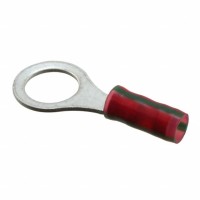
The TE Connectivity AMP Connectors SKU 2-320572-2, a ring tongue terminal for 22 AWG wire with a #5/16 stud size, is a deceptively simple component that demands precise interpretation of its datasheet to ensure reliable, high-vibration connections in industrial and automotive environments. As a crimp-style terminal, its electrical specifications are primarily dictated by the wire and the integrity of the crimp joint, rather than the terminal body itself. The key electrical parameter is the current rating, which for this component is typically defined by the 22 AWG wire's capacity, commonly around 7 to 10 amperes in free air, but derated significantly in bundled or high-temperature environments. The datasheet will specify a maximum voltage rating, often 300V or 600V, but this is primarily a function of the insulation (if any) and creepage distance on the mating stud. In practice, the contact resistance is the most critical electrical specification. A well-crimped TE terminal should exhibit a millivolt drop of less than 5 mV at rated current, indicating a gas-tight, low-resistance bond. Any reading above 10 mV suggests a poor crimp, potential oxidation, or insufficient wire insertion, leading to localized heating and eventual failure. The insulation, if present, is typically nylon or vinyl, with a dielectric strength exceeding 1500V, but this is irrelevant if the ring is used on a bare metal stud without proper clearance.
Absolute maximum ratings for this terminal are dominated by mechanical and environmental constraints, not electrical. The wire size range is strictly 22 AWG (with a typical insulation diameter up to 0.080 inches); using it on 24 AWG or 20 AWG wire will compromise the crimp's tensile strength and electrical contact area. The stud size is #5/16, meaning the hole diameter is nominally 0.312 inches, with a tolerance of +0.005/-0.002 inches. Derating considerations are critical: the terminal's brass or tin-plated copper body has a maximum operating temperature of 105°C, but this is limited by the wire insulation and the crimp's mechanical stability. For every 10°C above 85°C, the current rating of the wire must be derated by approximately 15-20%. In high-vibration environments, such as near an engine or industrial motor, the terminal's tensile strength after crimping must exceed 25 pounds-force for 22 AWG wire, per TE's application specifications. Repeated thermal cycling can cause the brass to work-harden, increasing the risk of cracking at the ring-to-barrel transition, so designers should avoid using this terminal in applications exceeding 1000 thermal cycles from -40°C to 125°C. The crimp height is another absolute parameter: for a 22 AWG wire, the specified crimp height is typically 0.053 inches for the conductor barrel and 0.108 inches for the insulation barrel (if applicable). Deviations of more than 0.002 inches will degrade pull-out force and increase resistance.
For typical application circuit analysis, this ring terminal is used to create a secure, removable connection to a stud or bolt, often on a power distribution block, battery terminal, or grounding point. The circuit path is straightforward: the 22 AWG wire is stripped, inserted into the terminal's barrel, and crimped using a precision tool like the TE 1490493-1. The ring is then placed over a #5/16 stud and secured with a nut. In a typical power supply circuit, this terminal might carry the output of a 12V DC regulator, where the maximum continuous current is 5A. The critical analysis point is the voltage drop across the junction: if the stud or bolt is steel or aluminum, galvanic corrosion can occur, increasing resistance over time. The datasheet will recommend using a star washer or anti-oxidation compound to maintain low impedance. In signal circuits, such as a sensor ground, the terminal's low inductance (less than 10 nH) is beneficial for avoiding ground loops. The ring's large surface area provides a low-inductance path, but the crimp itself introduces a small series resistance (typically 1-2 milliohms). For high-frequency circuits above 1 MHz, the ring's geometry can act as a small antenna, so the datasheet's recommended torque (usually 15-20 in-lbs for a #5/16 nut) must be observed to minimize microphonic noise from vibration.
Pin configuration is irrelevant for a single-terminal ring; instead, focus on the package considerations. The terminal is supplied loose or in tape-and-reel for automated crimping. The barrel has a distinct seam and a funnel entry to guide the wire. The ring tongue has a flat profile with a smooth inner diameter, and the overall length is typically 0.900 inches. For high-density applications, the ring's width of 0.469 inches must be considered to avoid shorting to adjacent terminals. The insulation sleeve, if present, has a color code per industry standards (red for 22-18 AWG). Thermal management guidelines are straightforward but often overlooked. The terminal acts as a heat sink for the crimped wire, but its thermal conductivity is limited. For currents above 5A, the heat generated at the crimp (I²R) must be dissipated. The datasheet will show a temperature rise curve; for example, at 7A, the terminal temperature may rise 30°C above ambient in still air. If the terminal is mounted on a large metal chassis, this effectively sinks heat, reducing rise by 40-50%. Conversely, if it's in a plastic enclosure with no airflow, derating by 20% is necessary. Using multiple wires on the same stud does not increase thermal capacity; each terminal must be individually derated.
Interpreting the characteristic curves and timing diagrams is essential for quality assurance. The primary curve is the crimp height vs. pull-out force, which appears as a bell-shaped curve. The datasheet will show an optimal crimp height range, typically 0.051-0.055 inches for 22 AWG wire, where the pull-out force exceeds 25 pounds. Too high a crimp height (loose crimp) reduces force to under 10 pounds; too low (overcrimped) can fracture the wire strands, also reducing force. There is no timing diagram in the traditional sense, as this is a passive component. However, the insertion force vs. wire size curve shows that 22 AWG solid wire requires more insertion force than stranded wire. For automated assembly, the crimp force monitoring curve is critical: it shows a characteristic profile with a peak at the point of insulation crimp and a plateau during conductor crimp. A deviation of more than 10% from the standard profile indicates a misfeed or wire misalignment. The voltage drop vs. temperature curve shows a linear increase per the copper temperature coefficient, but a sudden nonlinear rise above 100°C indicates incipient oxidation. In practice, engineers should use these curves to set acceptance criteria: the crimp height must be within the "green zone" of the pull-out curve, and the voltage drop at 1A must be below 0.5 mV for a new terminal. Always cross-reference the datasheet's application tooling specifications; using a generic crimp tool from a different manufacturer will invalidate the performance data and likely produce unreliable connections. The TE 2-320572-2 is a robust component when properly interpreted, but its seemingly simple nature belies the precision required in crimp height, wire strip length, and torque application to achieve the rated 25+ pound pull-out force and sub-milliohm contact resistance.