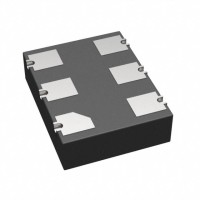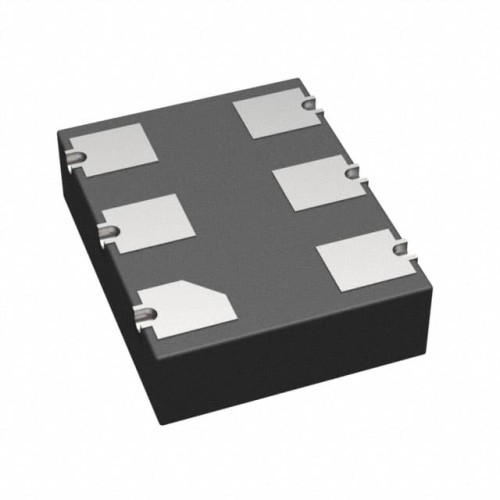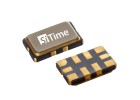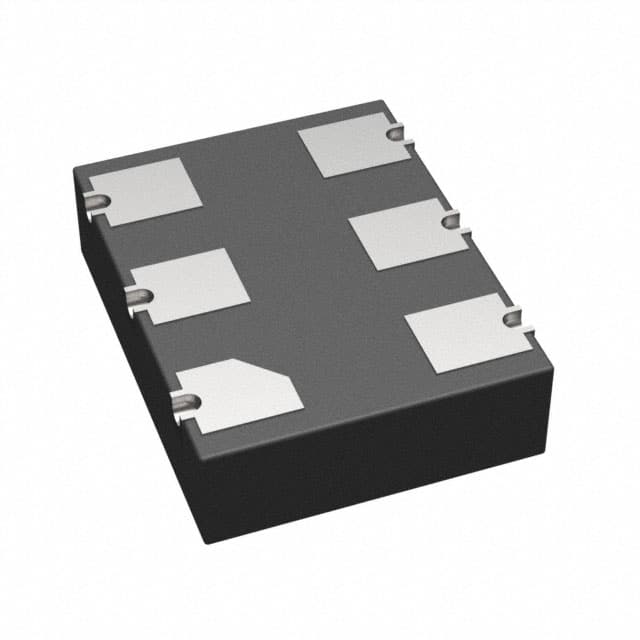
The electronic component at the center of our analysis, the SiTime SIT3372AC-1B9-28NX204.800000, is a MEMS-based Voltage-Controlled Crystal Oscillator (VCXO) operating at a precise 204.8000 MHz with LVPECL output. This specific device represents a paradigm shift in timing technology, moving away from legacy quartz-based solutions to a silicon Micro-Electromechanical Systems (MEMS) approach. The core innovation lies in the manufacturing process: instead of mechanically lapping and tuning a quartz crystal, SiTime etches a silicon resonator using standard semiconductor fabrication techniques. This allows for superior integration, smaller footprints, and dramatically improved reliability. Recent innovations include the use of "TempFlat" technology, which compensates for frequency drift over temperature without the need for external compensation components, and the implementation of "DualMEMS" architectures that enhance vibration resistance and phase noise performance. For a high-frequency part like the 204.8 MHz LVPECL VCXO, the MEMS approach enables lower jitter and better stability across industrial temperature ranges than many comparable quartz oscillators.
Market trends for this component segment are exceptionally strong, driven by the insatiable demand for higher data rates and more precise timing. The 204.8000 MHz frequency is not arbitrary; it is a critical multiple for high-speed serial interfaces like 10 Gigabit Ethernet, Fibre Channel, and various wireless backhaul standards. The primary demand drivers are the buildout of 5G infrastructure, the expansion of data center switching and routing capacity, and the proliferation of edge computing nodes that require deterministic timing. As baseband processing units and network interface controllers push beyond 100 Gbps and 400 Gbps, the need for ultra-low phase noise clocks at this exact frequency has become a bottleneck. Procurement teams are reporting a sustained shift from general-purpose quartz oscillators to programmable MEMS solutions due to their shorter lead times and better long-term supply assurance.
Supply chain dynamics for this SiTime component are currently more favorable than for traditional quartz VCXOs. The global sourcing picture is dominated by SiTime's semiconductor foundry partners, primarily in Taiwan and the United States, which allows for higher production scalability. Lead times for the SIT3372 series have stabilized to approximately 8-12 weeks, a significant improvement from the 20-30 week lead times seen for many high-frequency quartz VCXOs during the peak of the component shortage. The pricing outlook is cautiously optimistic. While the MEMS die itself is cost-competitive, the LVPECL output stage and the high-frequency specification (204.8 MHz) command a premium. However, as SiTime continues to ramp volume and leverage 300mm wafer production, we anticipate a 5-8% year-over-year price erosion for standard variants. The key risk remains allocation for advanced CMOS nodes used in the MEMS controller ASIC, but this is less volatile than the supply of raw quartz crystals.
Emerging applications are creating new demand vectors for this precise VCXO. Beyond traditional telecom, the 204.8 MHz LVPECL oscillator is finding a critical role in advanced driver-assistance systems (ADAS) and autonomous vehicle platforms. These systems require highly accurate time-stamping for LiDAR, radar, and camera data fusion, where a 204.8 MHz clock provides the necessary resolution for object detection and ranging. Another high-growth area is test and measurement equipment, particularly for 5G NR (New Radio) signal generators and spectrum analyzers that need a clean, tunable reference. Furthermore, the aerospace and defense sector is adopting MEMS VCXOs for radar and electronic warfare systems where resistance to shock and vibration is paramount, a weakness of traditional quartz oscillators. The ability to voltage-control the frequency also makes this component ideal for phase-locked loops (PLLs) in software-defined radios.
The technology roadmap for MEMS VCXOs like this SiTime device points to further integration and performance enhancement. The next logical step is the integration of the entire timing tree into a single package, combining the MEMS resonator, the VCXO control circuit, and a PLL into a "timing system-on-chip." We also expect to see the emergence of devices supporting higher frequencies, moving toward 400 MHz and beyond, to meet the needs of 800G Ethernet and next-gen PCIe Gen 6 interfaces. Phase noise performance will continue to improve, potentially rivaling that of oven-controlled crystal oscillators (OCXOs) in the near future, but without the power and size penalty. For the SIT3372 series specifically, SiTime is likely to release variants with extended temperature ranges (-55°C to +125°C) and enhanced vibration immunity for the most demanding industrial and automotive environments.
Industry regulations have a direct impact on the qualification and sourcing strategy for this component. The SIT3372AC-1B9-28NX204.800000 is fully compliant with RoHS (Restriction of Hazardous Substances) and REACH (Registration, Evaluation, Authorisation and Restriction of Chemicals), which is a baseline requirement for all shipments into the European market. More significantly, SiTime has been aggressively pursuing automotive qualifications like AEC-Q100 for its MEMS oscillators. While this specific SKU may not be listed as automotive-grade, the platform architecture allows for a straightforward path to qualification. Procurement teams must verify the exact regulatory status for their target application, as failure to comply with REACH updates or automotive reliability standards can lead to costly redesigns. The inherent reliability of MEMS—with no moving parts subject to wear—also helps in meeting long-life industrial requirements.
Strategic recommendations for procurement teams are clear. First, given the favorable lead times and the trend toward silicon-based timing, we recommend qualifying the SIT3372AC-1B9-28NX204.800000 as a preferred or sole source for new 204.8 MHz designs. This reduces dependency on quartz suppliers with historically volatile supply. Second, establish a 6-9 month rolling forecast with your distributor to secure allocation, especially for the LVPECL variant which is less commonly stocked than standard CMOS outputs. Third, consider designating a "last-time buy" window for any legacy quartz VCXOs at this frequency, as the MEMS alternative offers superior performance and lower total cost of ownership. Finally, engage with SiTime's field application team early in the design phase to explore programmable variants that could consolidate multiple frequency requirements into a single bill of materials, thereby reducing inventory complexity and mitigating the risk of obsolescence.